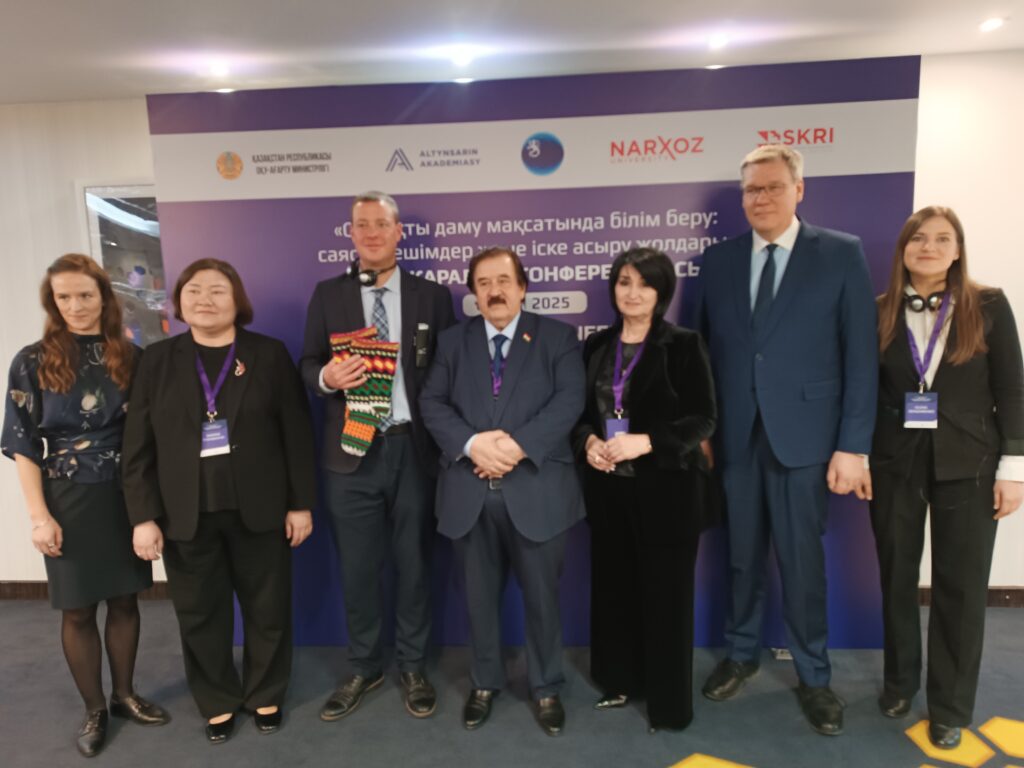
Several Central Asian countries are taking decisive steps to incorporate sustainable development into their respective national education systems. At the recent conference “Education for Sustainable Development: From Policy to Practice”, held in Astana on 4 April, international experts and education professionals gathered to discuss how to translate environmental and social priorities into classroom realities.
Inspired by Kazakhstan’s notable progress in integrating sustainability into school curricula, representatives from across the region highlighted shared challenges and ambitions. With over 80 million people and a predominantly young population, Central Asia is grappling with urgent sustainability issues such as climate change, drought, desertification, and social inequality. Addressing these concerns has become a top priority.
In recent years, Kazakhstan has implemented a large-scale initiative to integrate sustainable development components into the school curriculum, supported by the Embassy of Finland in Kazakhstan and the UNESCO Regional Office in Almaty.
This work is led by the Ibray Altynsarin National Academy of Education (NAE), a scientific centre under the Ministry of Education of Kazakhstan responsible for providing academic and methodological support for the national education system. The Academy has already embedded topics related to all 17 UN Sustainable Development Goals into standard primary and secondary school programmes across various disciplines.
The Sustainable Kazakhstan Research Institute (SKRI) at Narxoz University – a private institution supported by the businessman and philanthropist Bulat Utemuratov – is providing funding and expertise to successfully implement the program.
In 2023, the initiative, supported by the SKRI’s director, Dr Brendan Duprey, was shortlisted for the UNESCO-Japan Prize as one of the world’s best projects in education for sustainable development. Inspired by this success, The NAE together with the SKRI at Narxoz University seek to expand the initiative to neighbouring countries–Kyrgyzstan, Tajikistan and Uzbekistan. Seed funding has been provided to launch the program by the Embassy of Finland. An extensive fundraising campaign is currently underway to secure additional funds for its regional implementation.
‘We in Finland recognize the essential role of education in achieving climate and sustainability goals’, Janne Heiskanen, Ambassador of Finland to Kazakhstan and Kyrgyzstan, said at the conference. ‘This led to our partnership with the Sustainable Kazakhstan Research Institute at Narxoz University four years ago. Their approach of integrating sustainable development goals in formal education is visionary, but it’s also very practical.’
Kazakhstan, a model for other Central Asian nations in terms of sustainability education, is now aiming even higher. The country is considering joining the Greening Education Partnership, a global initiative that would help build the capacity of local professionals and create relevant standards, including green school frameworks.
There are already individual examples of eco-oriented schools in Kazakhstan. Since 2021, the Bulat Utemuratov Foundation has been running the Green Schools project in three cities – Almaty, Astana, and Shymkent – covering around 40 schools. These schools are equipped with greenhouses where students grow vegetables and participate in science projects. The sustainable development agenda is also being implemented in Kazakhstan’s leading internationally accredited schools – Haileybury, Tamos, and Nazarbayev Intellectual Schools.